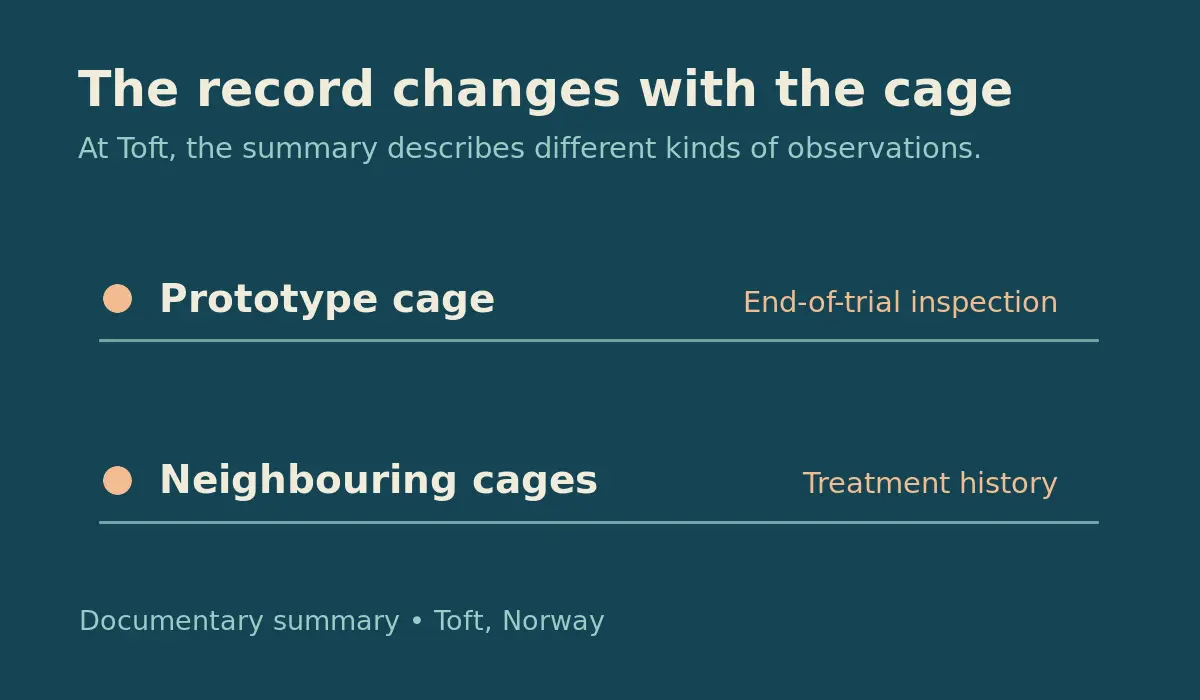
The historical prototype trial at Toft in Norway gives a reader two observations about sea lice. The CLOSEDFISHCAGE summary reports finding none on the fish checked in the prototype at the end of the validation trial. It then says that fish in three neighbouring traditional cages had been treated for sea lice three times. The two sentences appear side by side. Read them as a comparison and the word that matters most is checked. CLOSEDFISHCAGE final summary, potential impact.
What would belong in the second column?
The first sentence describes an inspection at a stated point in time. Its natural counterpart would be a similarly timed inspection in the other cages, with a clear account of which fish were checked. The second sentence gives a treatment history. A corresponding fact for the prototype would be its own treatment history over the same period. Each record helps explain what happened at Toft. Each is answering a different question.
Sharing a site is still useful context. It means the neighbouring-cage history belongs to the same farm, and the report specifies that the prototype fish came from a neighbouring cage. The summary also gives the general timing of the work and describes a fish observation period. Its short account leaves open how often comparable observations were recorded across the cages, or how treatment dates related to the final inspection.
Read the limits through an imaginary log
In a fictional farm log, imagine that two cages both read “none found” at a Friday inspection. One cage also had a treatment recorded earlier in the month. The Friday entries can be compared as observations if the records use comparable checks. The two entries alone give little information about the course of the month. A blank cell for an earlier inspection could mean that no record survived.
The most helpful reading of the Toft paragraph keeps the final check, the nearby treatment history and the time limits visible. If a later report makes a claim about how often lice occurred over the whole trial, look for a record giving the time and scope of comparable checks. The original paragraph then remains valuable for the event it actually reports.