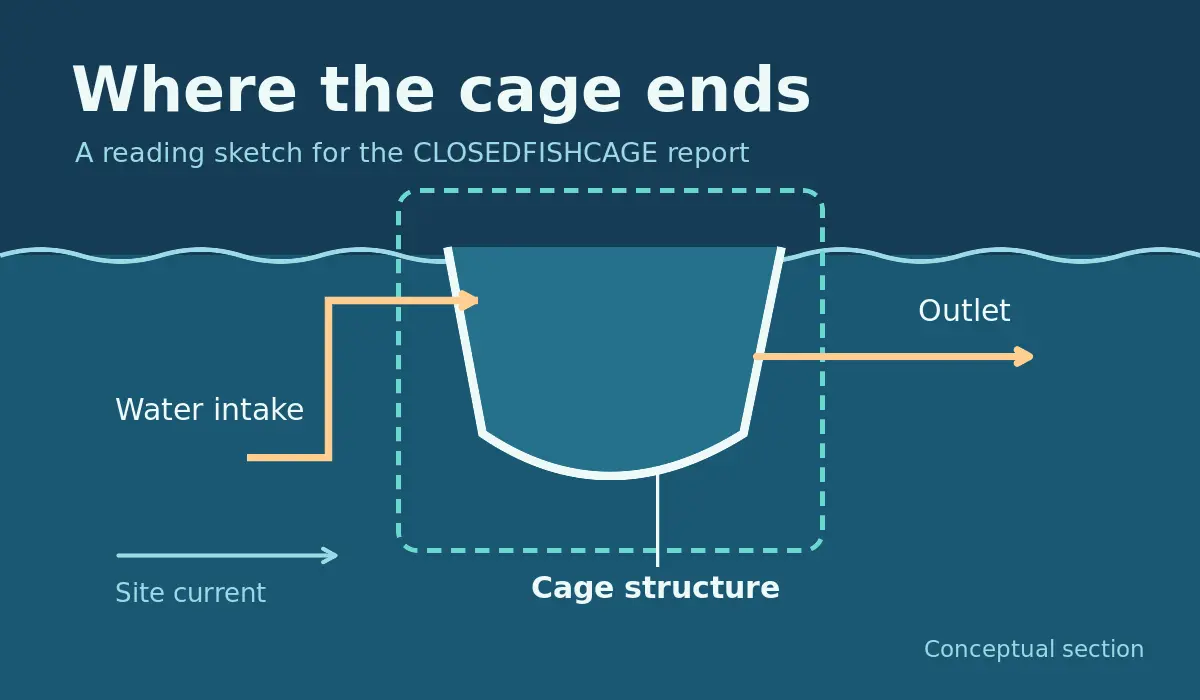
Trace the wall of a closed fish cage and you can see what separates the fish from the surrounding sea. Trace the inlet and the outlet, and you have a different drawing. The water crosses the wall both ways. For a question about the water the fish actually occupy, the useful boundary includes the equipment that handles that exchange.
What the historical record puts inside
The European Commission’s CLOSEDFISHCAGE final summary describes the work in packages. The cage package covers material selection and the design of the closed net. A separate package covers water intake at different depths, inlet and outlet design, circulation inside the cage, and sensor and control systems. Another package integrates the two. Those divisions give a reader a way to reconstruct the system while keeping each design question attached to the relevant part.
Start with a cross-section. Draw the waterline and the cage wall. Put the depth of the intake on the sea side of the sketch, then follow that line into the cage. Draw a second line for water leaving. A dashed box around the wall and water-handling equipment works for a question about circulation or the conditions inside. Keep the local current and water column outside that box and give them labels of their own. CLOSEDFISHCAGE final summary, work packages 2–4.
Change the intake and keep the cage
Imagine two records for the same cage body, one with a shallow intake and one drawing from deeper water. Under a hypothetical temperature difference between those depths, the inlet temperatures could differ while the liner and outlet remained the same. A temperature difference inside the cage would then have at least one plausible explanation upstream. To trace it, look for intake depth and the recorded temperature of the entering water alongside the internal measurement.
Move the dashed line again if the question is about the receiving water around the outlet. That requires observations beyond the cage and a way to relate them to the discharge. The original project fact sheet describes an engineering objective for a sea-based cage. Its design ambition supplies a starting point for the sketch, while the reach of any site-specific conclusion comes from the measurements in the relevant trial. European Commission project fact sheet.